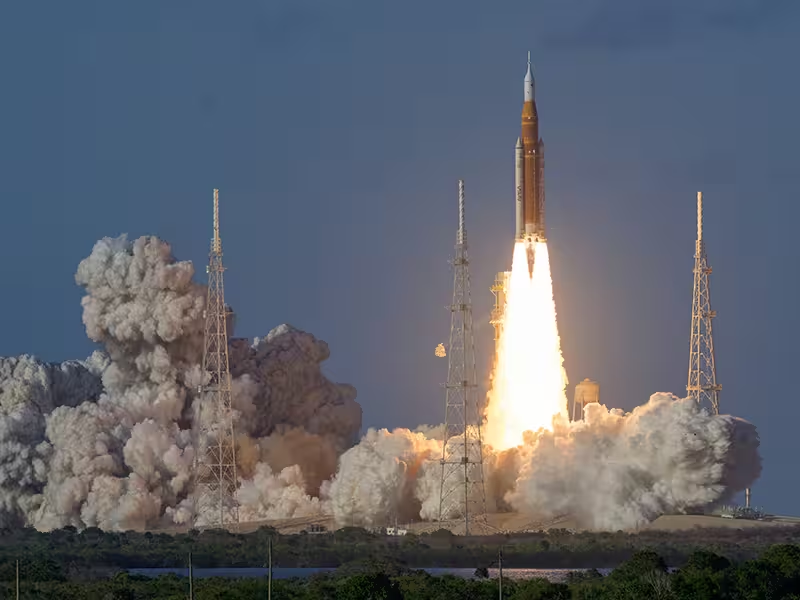
Even though rocket launches happen where I live, they never get old.
Last month, four astronauts headed to circle the moon—three making history: the first woman, the first Black pilot, the first Canadian.
It’s incredible.
But what stays with me even more isn’t just the launch… it’s everything behind it. The thousands—maybe hundreds of thousands—of people who made it possible.
Engineers. Designers. Technicians. Problem-solvers.
And long before them?
Teachers. Mentors. School systems.
Because none of this happens without someone, somewhere, who took the time to teach, to support, to believe.
The Story We Don’t See
Here’s what I keep thinking about: How many of the people behind that rocket learned differently? How many needed supports… or faced challenges we couldn’t see?
How many had ADHD, dyslexia, anxiety, hearing or vision differences, or other disabilities, and still found their way into this work because someone made learning accessible?
We celebrate the launch. But the real story is everything behind it. Every scaffold. Every adaptation. Every teacher who said, “You belong here too.”
This Is Where Systems Matter
At the Center on Inclusive Technology & Education Systems (CITES), this isn’t a side conversation—it’s the work. Because access isn’t an add-on. It’s infrastructure.
CITES helps schools and systems move beyond isolated tools or one-off supports and instead build inclusive technology ecosystems where:
- Assistive technology, edtech, and IT work together (not in silos) with family input integrated throughout;
- Accessibility is built in from the start—not retrofitted later;
- Universal Design for Learning (UDL) drives decisions;
- Supports are available across all tiers of a multi-tiered system of supports, not just when students struggle.
Using the CITES Framework, districts create shared visions, conduct self-assessments, and build implementation roadmaps that answer a critical question: Are we designing systems where every learner can access, engage, and succeed from day one?
Because when we do, we don’t just change outcomes for individual students.
We change what’s possible.
From Access to Achievement to Impact
When a student can use text-to-speech, captions, or flexible tools…they’re not getting an advantage. They’re getting access. And access leads to participation.
Participation leads to confidence. Confidence leads to opportunity. And one day, that student becomes the engineer. The coder. The mission specialist.
The innovator behind the next launch.
“Shoot for the moon” isn’t just a saying.
It’s what becomes possible when we design learning environments where everyone belongs from the beginning. When we stop asking, “Can this student succeed here?” And start asking, “How do we design this so every student can?”
Because the next giant leap for humanity? It’s not just happening in space. It’s happening in classrooms—where inclusive systems, thoughtful design, and relentless belief make sure no potential is left behind.