Editor’s note:
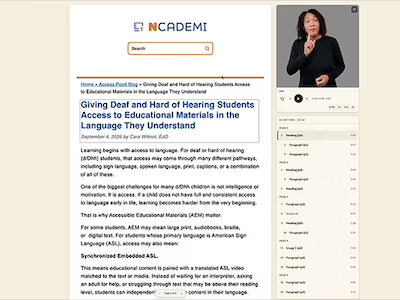
Read this blog post as an interactive text-to-ASL demonstration.
Learning begins with access to language. For deaf or hard of hearing (d/Dhh) students, that access may come through many different pathways, including sign language, spoken language, print, captions, or a combination of all of these.
One of the biggest challenges for many d/Dhh children is not intelligence or motivation. It is access. If a child does not have full and consistent access to language early in life, learning becomes harder from the very beginning.
That is why Accessible Educational Materials (AEM) matter.
For some students, AEM may mean large print, audiobooks, braille, or digital text. For students whose primary language is American Sign Language (ASL), access may also mean:
Synchronized Embedded ASL.
This means educational content is paired with a translated ASL video matched to the text or media. Instead of waiting for an interpreter, asking an adult for help, or struggling through text that may be above their reading level, students can independently access the content in their language.
Why Captions Are Not Always Enough
Captions support literacy development, vocabulary growth, and access for many learners.
However, captions are not automatically accessible for every d/Dhh student.
Captions are only accessible if a student can read them with enough speed and understanding to keep up with the content. Young children in preschool through second grade who are still developing early reading skills may not yet be able to independently access captioned media at all. Research also suggests that students generally need at least a fourth-grade reading level with fluency to effectively use captions. That may be sufficient when the material is written at an elementary level, but a high school biology lesson, history documentary, or technical training video often contains text written at a much higher reading level. If a student is reading below grade level, captions alone may not provide full access to grade-level media.
For students whose language is ASL, Synchronized Embedded ASL may provide more direct access to educational media.
This is not about lowering expectations. It is about ensuring students can access grade-level media in a language they fully understand.
Access to Reading: From Text-to-Speech to Text-to-Sign Language
Students spend much of their school day reading textbooks, novels, digital assignments, assessments, and online resources. Students who have reading disabilities or are blind/visually impaired are often provided with assistive technology that converts text to synthetic speech. Accessible media producers such as Bookshare and the American Printing House for the Blind (APH) provide repositories of accessible educational materials that work with assistive technology. Supported through federal programs and partnerships, these services help ensure students have access to print materials that might otherwise be inaccessible.
But what about students whose primary language is ASL?
If text-to-speech (TTS) provides access to text through listening, text-to-sign language (TT-SL) has the potential to provide similar access through sign language.
For students who learn through ASL, TT-SL may offer a more direct way to access textbooks, literature, academic articles, and digital learning materials in their strongest language.
This raises an important question: if schools provide TTS for students who access language through listening, how do they provide similar access for students who access language through sign?
What This Can Look Like in Real Schools
Live interpretation and pre-translated materials are not the same.
Interpreters do incredible work, but classroom interpretation happens in real time and depends on pacing, preparation, and classroom conditions.
Synchronized Embedded ASL offers something different:
- consistent delivery
- repeated viewing
- independent access
- the ability to pause, rewind, and review
- exposure to multiple fluent d/Dhh language models
These resources can also become language-learning tools for families at home.
When more than 90% of d/Dhh children are born to hearing parents, that matters.
Real Examples Already Happening
This is not future technology. Schools can access these resources right now.
The Described and Captioned Media Program (DCMP)
DCMP, funded by the U.S. Department of Education and available at no cost to eligible users, has long been a trusted source for captioned educational media.

Now DCMP is expanding access with its ASL Pop-Up Player, which allows students to:
- watch educational videos with ASL translation
- resize the signer
- move the signer on the screen
- learn from a variety of fluent d/Dhh signers
Partnership in Action: DCMP and PBS Kids
DCMP continues to expand what educational media can look like for d/Dhh learners. Through its growing investment in ASL access, DCMP is partnering with organizations such as PBS Kids to bring language-rich educational programming to children and families in ASL.
Families can already access full PBS Kids episodes with ASL translation.
Language development does not stop when the school day ends. It allows families to continue building vocabulary and ASL fluency at home.
Schools Can Also Create Their Own Materials
One of the most exciting changes in educational access is that schools and organizations are beginning to have more tools to create AEM in ASL themselves.
For years, students with disabilities have benefited from federally supported accessibility systems that provide access to braille, large print, audiobooks, and digital text through organizations such as Bookshare and the American Printing House for the Blind (APH).
Comparable systems for ASL access have been far more limited. However, several organizations and businesses are working to make ASL translation services more available and affordable for schools.
Today, schools can partner with ASL translation providers to translate both media and print materials into ASL. These services can support classroom videos, digital lessons, textbooks, handouts, and other instructional resources.
New technologies are also helping streamline the translation process. Artificial intelligence is not replacing human translators. Instead, it can help organize source materials, estimate the amount of translation work needed, and simplify production tasks. This can provide schools with more reliable cost estimates, clearer timelines, and better planning for accessibility projects.
Cirrus Translate is also developing Sign Language Studio, with a projected release in fall 2026. The platform is designed to allow schools, agencies, and organizations to work directly with their own qualified sign language translators to create TT-SL materials for documents and instructional resources.
Tools like Sign Language Studio could make it easier for districts to develop ASL embedded accessible materials in-house, expanding access while reducing reliance on outside vendors.
This blog includes an example of TT-SL provided by Cirrus Translate. The translation demonstrates what TT-SL can look like when applied to educational content and provides a glimpse of how future TT-SL tools may support access to educational materials.
At the same time, DCMP has launched DCMP Create, a platform designed to help educators make their own classroom media more accessible. Many teachers now create videos, digital lessons, and online instructional materials, but accessibility is often added later or overlooked entirely.
This platform helps educators create media with:
- captions
- audio description
- sign language integration
The goal is to help schools create more accessible media in-house, instead of relying on outside companies. This also allows school staff to develop materials for their own students.
That shift could move ASL access from an occasional accommodation to a sustainable part of everyday instruction.
A Real Example from the Field
One example of accessible educational materials in action is DeafVerse, a free resource developed by the National Deaf Center on Postsecondary Outcomes.
DeafVerse is a choose-your-own-adventure learning experience that helps deaf teens explore transition skills through real-life scenarios. Students make decisions, see the outcomes of their choices, and build knowledge in three key areas: preparing for college, advocating for themselves, and developing confidence for the workplace.
Designed for use by families, teachers, vocational rehabilitation counselors, and Pre-Employment Transition Services (Pre-ETS) providers, DeafVerse includes student workbooks, teacher guides, and online learning materials presented in both English and ASL. The on-screen instruction is provided by Justin Perez, a Deaf performer known for his work in Visual Vernacular, creating an engaging and language-rich learning experience.
All of the lessons also align with the required Pre-ETS, making DeafVerse a practical resource that educators can immediately incorporate into transition planning and instruction.
Learn more about Pre-Employment Transition Services (Pre-ETS).
Why Schools Should Pay Attention
Educational equity discussions often focus on devices, internet access, or class size.
But for d/Dhh students, access begins earlier.
It begins with language.
Synchronized Embedded ASL can help schools:
- improve independent access to grade-level content
- strengthen bilingual development in ASL and English
- support family involvement
- reduce overreliance on adult support
- increase inclusion in general education settings
- create employment opportunities for d/Dhh adults as translators, consultants, and content creators
Most importantly, it gives students learning access in a language they fully understand.
And that is where real access begins.
To explore more resources, visit: AEM in ASL Resource Hub