
Download the Digital Accessibility Policy Scan (PDF)
Section 1. Purpose and Intended Audience

State and local educational agencies have long been responsible for ensuring K-12 students with disabilities can access educational programs and services, including instructional materials. In 2004, the Individuals with Disabilities Education Act (IDEA)[1] further specified this obligation by establishing requirements for the timely provision of accessible formats of print instructional materials (e.g., braille, large print, or audio files). States and school districts responded by developing related policies and guidelines (NCADEMI & NIMAC, 2024).
Since 2004, instruction has increasingly shifted from print to digital. Simply providing accessible formats of print materials does not adequately address the digital content and technology used in classrooms. However, until the 2024 Americans with Disabilities Act (ADA) Title II final rule[2], educational agencies lacked a specific technical standard for the accessibility of websites, mobile applications, and related digital content.
This report examines the status of K-12 digital accessibility policies and related guidelines published by U.S. governmental entities and educational jurisdictions, providing a baseline during the early implementation of the 2024 ADA Title II final rule. The findings are intended to help state education leaders, policymakers, and other decision makers identify opportunities to strengthen policy, guidance, and implementation supports needed for school districts to consistently provide accessible digital educational materials aligned with federal requirements.
Section 2. Context for Digital Accessibility in K-12 Education
The term “accessible” is often used in educational technology (edtech) contexts to describe whether devices and broadband connectivity are available, whether tools are easy to use, or whether a digital curriculum reflects a range of individual characteristics and backgrounds. In these cases, terms like “available,” “usable,” or “inclusive,” respectively, may be more accurate. When referring to digital access by individuals with disabilities, “accessible” is the appropriate term.
Just as schools follow established standards to ensure physical accessibility (e.g., ramps, elevators, tactile signage), digital materials are guided by established accessibility standards. In practice, this means students, staff, parents, and other community members with disabilities can access digital materials at the same time and with the same level of privacy, independence, and ease as those without disabilities.
For example:
- A school’s digital instructional materials have proper structure and markup, ensuring access by students with learning, sensory, and physical disabilities who use a wide range of assistive technology.
- A school’s learning management system and other edtech products work with voice recognition, enabling a teacher with involuntary muscle movements to utilize the required curriculum.
- Classroom instructional media have closed captions so a deaf parent can better access instructional videos to help support their child’s learning.
Together, these examples illustrate a proactive approach in which digital materials and technologies are accessible from the outset rather than made accessible after a barrier is encountered.
ADA Title II: New Clarity for Digital Accessibility

The ADA[3] has long required that state and local government entities, including public education agencies, ensure that individuals with disabilities are not excluded from or denied access to programs and services. Under Title II of the ADA, these obligations apply to all services, programs, and activities of public entities. Until recently, however, Title II did not specify how these requirements applied to digital materials used in K-12 schools.
In April 2024, the U.S. Department of Justice issued a final rule under Title II of the ADA establishing specific accessibility requirements for websites, mobile applications, and other digital content used by state and local government entities. This rule, titled “Nondiscrimination on the Basis of Disability; Accessibility of Web Information and Services of State and Local Government Entities” (89 FR 31320), provides long-awaited clarity by defining a minimum accessibility standard for digital content: version 2.1 of the Web Content Accessibility Guidelines (WCAG), Level AA.
While IDEA requires the provision of accessible formats to meet the individual needs of eligible students, ADA Title II requires state and local educational agencies to proactively ensure that digital materials used for teaching and learning are accessible from the beginning. For a more detailed explanation of the final rule and the accessibility standard it specifies, see A Primer on Title II of the ADA and the Web Content Accessibility Guidelines. A side-by-side comparison of ADA Title II and IDEA is also available.
Research on K-12 Digital Accessibility Policy and Practice
To date, there has been very limited research on digital accessibility policy and practice in K-12 education. Despite modest guidance from federal and state governments prior to 2024 (Shaheen & Lazar, 2018), some schools have been making progress. Unfortunately, that work is not well documented (Shaheen & Lohnes Watulak, 2019) and when published, can be difficult to locate.
A 2019 study of K-12 school websites indicated that schools across all demographic groups generally struggled to make their websites fully accessible. The researchers found that 95.5% of K-12 home pages had detectable WCAG 2 errors with home pages having an average of 24.3 detectable errors (Kimmons & Smith, 2019).
Two studies (Shaheen, 2022, 2025) explored how digital accessibility policy work transpires in schools. The 2022 study examined the work of five local educational agencies in four states. The findings explained that school district personnel had to navigate conflicting local interests to gradually progress toward their accessibility goals.
Shaheen’s 2025 research built on the 2022 study by incorporating state educational agencies and data from two additional states. The findings reinforced that policy enactment in schools is shaped by interconnected contextual factors that operate within a complex, multi-level ecosystem rather than independent influences. The study also identified numerous mediating factors across this ecosystem, including evidence that the actions of state educational agencies and school districts are mutually influential throughout the policy enactment process.
In a 2025 survey of state and local educational agency representatives, fewer than 10% of respondents reported that their agency was well-positioned to meet the new ADA Title II requirements (NCADEMI, 2025a). In this same study the state educational agency respondents identified significant barriers to meeting these requirements, such as limited awareness of digital accessibility, lack of clarity about their agencies’ role and responsibilities with respect to digital accessibility, and lack of guidance for teachers on selecting accessible materials (e.g., websites, apps). Respondents from school districts identified two significant barriers: 1) their agency not prioritizing digital accessibility and 2) vendors’ lack of understanding and support for accessibility. Both state and local educational agency respondents reported lack of teacher training on how to create accessible digital learning materials (e.g., documents, slide decks, videos) as a significant barrier.
Results from another 2025 national survey corroborated NCADEMI’s findings. The National School Public Relations Association (NSPRA) conducted a survey of its school district members, which showed that 52% of the districts represented in the sample were implementing the new ADA Title II requirements and of those, only 14% were close to compliance with the requirement (NSPRA, 2025). Only 29% said digital accessibility, beyond the district’s public-facing website, is a high priority. Similar barriers to those reported by NCADEMI were cited; specifically, limited awareness and lack of staff expertise and training.
Research Questions
Overall, findings from the available research reveal the need for stronger, more consistent state-level policy and guidance. The ADA Title II final rule defines long-awaited requirements, opening the opportunity for state educational agencies to partner with school districts on the development of policies and guidelines, as well as practical supports and resources. By leading the development and implementation of digital accessibility policies and practices, state educational agencies can serve as models for local implementation while reducing duplication of effort across local educational agencies.
This study sought to improve clarity on policy and practice by answering the following questions:
- What is the current landscape of state-issued policies related to the accessibility of digital educational materials provided by public K-12 schools?
- To what extent do those policies address key components of high-quality systems for providing accessible digital educational materials?
Section 3. Methods
For the purposes of this study, the term policy was interpreted broadly to refer collectively to government- or agency-developed documents and web content that establish or communicate ADA-related expectations for digital accessibility of educational materials used in public K–12 schools. The search was limited to publicly available documents and web content published by educational jurisdictions and governmental entities. Statutes, regulations, standards, requirements, guidelines, memos, executive orders, and related content addressing digital accessibility in K-12 education were included in the scan process. Appendix A provides the full policy scan methodology.
The research team searched for digital accessibility policies on the websites of 58 U.S. governmental entities and educational jurisdictions. To verify, update, or expand the policy findings, the team communicated with the State Educational Technology Directors Association (SETDA) member or State Accessible Educational Materials (AEM) Contact for each jurisdiction (Appendix B).
Section 4. Policy Search Results
Appendix C presents the full results of the policy scan. Web accessibility statements were the most identified policies across the search results. Of the 58 educational jurisdiction websites searched, most had an independent web accessibility statement (n=34, 59%) or referred to a statement issued by that education jurisdiction’s higher-level governmental entity (i.e., state, territory; n = 16, 28%). Of the 58 websites of the corresponding governmental entities, 54 (93%) had a web accessibility statement. However, most accessibility statements, whether issued by an educational jurisdiction or governmental entity, were limited in scope and directly related to the accessibility of the given governmental website. While some accessibility statements extended to electronic information and communication technology beyond a website, none addressed the accessibility of school districts’ digital educational materials.
The next most common policy type identified was web or digital accessibility policies published within the 58 state or other governmental entities (n=28, 48%). These policies varied in comprehensiveness (e.g. purpose, scope, standards, responsibility, requirements). Like accessibility statements, the applicability of most identified policies was limited to the given website or other digital assets operated or procured by the state or governmental entity, so did not extend to school districts’ digital educational materials.
For five state governments (8.6%), including California, Colorado, Illinois, Missouri, and New Jersey, the team identified formal statutes or regulations that mandate state-governed websites and other electronic and information technology be accessible to individuals with disabilities. With the exception of Colorado, these statues and regulations did not specify applicability to school districts.
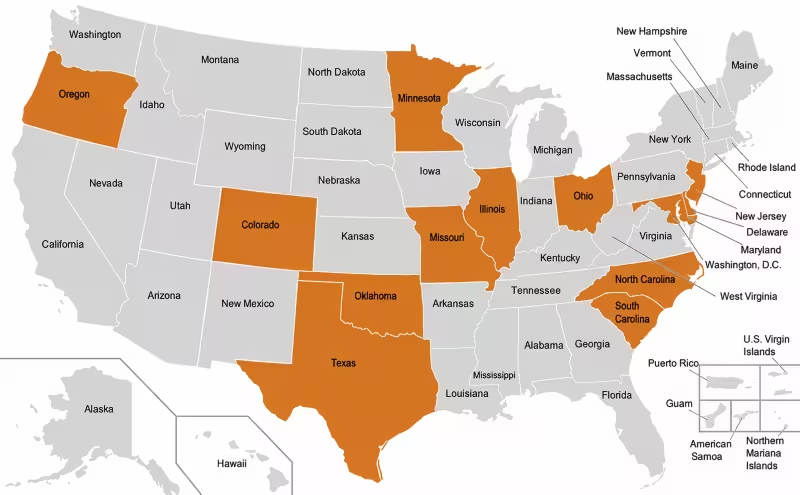
Despite the prevalence of web accessibility statements and broader governmental digital accessibility policies, the scan identified only 12 states that address the accessibility of digital educational materials used in public K–12 educational agencies (Figure 1). These were categorized as state government statutes or regulations and state educational agency requirements or guidelines, as presented below.
State Government Statutes or Regulations Addressing Educational Materials
Statutes or regulations addressing the accessibility of school districts’ digital educational materials were identified for six states:
- Colorado Digital Accessibility Law (House Bill 21-1110 and Senate Bill 23-244) has two parts for public entities, including school districts. First, it requires public entities to publish a technology accessibility statement with two methods of contact. Second, public entities must meet at least one of five additional compliance options. The research team noted that Colorado’s procurement requirements are specific to “State executive branch agencies” and exclude the Colorado Department of Education and school districts.
- Illinois Public Act 102-0238 states in part, “To ensure that the content available on an Internet website or web service of a school district is readily accessible to persons with disabilities, the school district must require that the Internet website or web service comply with Level AA of the World Wide Web Consortium’s Web Content Accessibility Guidelines 2.1 or any revised version of those guidelines.” The law specifies that “Internet website or web service” is “any third party online curriculum that is made available to enrolled students or the public by the school district through the Internet.”
- Code of Maryland Regulations Section 13a.06.05.06 states in part, “Each local board of education and public agency shall comply with WCAG 2.1 Level AA (June 5, 2018) when purchasing or selecting digital learning resources to provide equitable learning opportunities for all students.” Additionally, Maryland Code Ann., Educ. § 7-910 “requires that on or before October 1, 2023, and each October 1 thereafter, each Local Education Agency (LEA) shall submit a report to [Maryland State Department of Education] on the accessibility of the digital tools developed or purchased for use during the immediately preceding fiscal year.”
- New Jersey Statutes Annotated 18A:36-35.1 “requires Internet websites and web services of school districts, charter schools, renaissance schools, and the Marie H. Katzenbach School for the Deaf to be accessible to persons with disabilities.” Schools must submit a statement of assurance to the New Jersey Department of Education every two years, which attests that its internet website or web service complies with Level AA of the current version of the Web Content Accessibility Guidelines. “Internet website or web service” includes any webpage, website, web service, online curriculum, or online third party or open educational resource product.
- Ohio Administrative Rule 3301-51-21 states in part, “Digital instructional materials and technologies must conform to the standards for accessibility set forth in Section 508 of the Rehabilitation Act of 1973, 29 U.S.C. 749, and 36 C.F.R. 1194. Local education agencies are required to ensure compliance of materials used in their schools.” It’s important to note that this Ohio Administrative Rule is distinct from the other state laws because it is embedded within special education.
- Oregon Administrative Rule 581-011-0087 states in part, “Materials shall be accessible consistent with [a series of Oregon Administrative Rules under textbook adoption] and compliant with all state or federal laws regarding accessibility. A publisher that offers digital, electronic, or web-based materials must provide an accessibility conformance report for each electronic component that documents adherence to the Web Content Accessibility Guidelines (WCAG) identified in the circular of information and technical standards required by the Federal Rehabilitation Act, Section 508. The report must be based on an audit testing a random sampling of each different type of electronic component as outlined in each circular of information.”
State Educational Agency Requirements and Guidelines
Requirements or guidelines addressing the accessibility of school districts’ digital educational materials were identified for seven state educational agencies:
- Minnesota Department of Education Product and Vendor Accessibility Checklist states in part, “Software products considered for procurement must be readily usable and accessible and provide, at a minimum, functionality outlined in the World Wide Web Consortium (W3C) Web Content Accessibility Guidelines (WCAG) 2.1, Level A and AA1. If no product exists that meets this criteria at time of purchase, the vendor must demonstrate a willingness to provide a timely road map for correcting each accessibility issue found during formal assessment and must make meaningful progress toward meeting that timeline. Each vendor’s claim of accessibility must be verifiably true.”
- Missouri Department of Elementary and Secondary Education Accessible Educational Materials (AEM) Guidance Document “provides tools and resources that can be utilized to make the curriculum more accessible for students.” The document addresses requirements specific to both accessible formats under IDEA and accessible digital materials under ADA Title II.
- North Carolina Department of Public Instruction hosts a Digital Accessibility hub. This is a comprehensive collection of guidelines for districts to create, evaluate, and procure accessible digital materials.
- Oklahoma State School Boards Association ADA Digital Accessibility FAQ “is designed to help school districts understand the new federal digital accessibility requirements that apply to websites, documents and other online content.”
- Oregon Department of Education Digital Instructional Materials Toolkit provides school districts with curriculum adoption practices. The document includes guidance for including digital accessibility requirements in procurement procedures. Note that a statute was identified for Oregon and listed earlier in this section (Oregon Administrative Rule 581-011-0087).
- South Carolina Department of Education (SCDE) Digital Accessibility Requirements Summary for Public School Districts is a one-page PDF focused on what districts need to know about the ADA Title II final rule. SCDE Summary of Federal Requirements for District Website Accessibility addresses ADA, Section 504, and Section 508. Additionally, SCDE Digital Accessibility Resources includes guidance developed by the agency.
- Texas State Board of Education Request for Instructional Materials Review and Approval Cycle 2026 states in part, “Any student or teacher components offered to local school systems in a digital format must comply with the Web Content Accessibility Guidelines (WCAG), version 2.1, level AA standards and the technical standards required by the Federal Rehabilitation Act, Section 508. Publishers must, at their own expense, contract with a reputable third party to evaluate accessibility, produce an accessibility compliance report, and complete the required coversheet. Any findings of noncompliance must be remedied as a condition of approval.”
Note that Oregon was included in both categories, making the total number of states represented equal to 12.
Section 5. Policy Content Analysis
Each policy across the 12 states was evaluated using NCADEMI’s Quality Indicators for the Provision and Use of Accessible Digital Educational Materials (NCADEMI, 2025b). The Quality Indicators define the actions state and local educational agencies take to build sustainable systems that achieve continuous improvement in the selection, procurement, creation, evaluation, and use of digital educational materials that work for students with and without disabilities.
The policies were analyzed against specific components from two Quality Indicator domains:
- Leadership Commitment to Digital Accessibility: Six components that demonstrate meaningful actions taken by leadership.
- Integration of Accessibility in Instructional Materials Review and Procurement: Five components that demonstrate accessibility in multiple stages of adoption.
Researchers assessed whether the component was clearly addressed, somewhat addressed, or not addressed in the policy. The policy content analysis method is available in Appendix D.
For the first domain, policies from all applicable states (n=12) were included in the content analysis: Colorado, Illinois, Maryland, Minnesota, Missouri, New Jersey, North Carolina, Ohio, Oklahoma, Oregon, South Carolina, and Texas. Table 1 presents the results.
Table 1. Results of Policy Content Analysis: Commitment from Leadership (n=12)
| Quality Indicator Component | Clearly Addressed | Somewhat Addressed | Not Addressed |
|---|---|---|---|
| 1.1. A cross-disciplinary steering committee, team, or equivalent to coordinate the agency’s digital accessibility efforts and implementation programs is cited. | 4 (33.3%) | 0 | 8 (66.7%) |
| 1.2. A publicly available statement of purpose or commitment to digital accessibility is present. | 7 (58.3%) | 0 | 5 (41.7%) |
| 1.3. A definition of digital accessibility is provided. | 6 (50.0%) | 1 (8.3%) | 5 (41.7%) |
| 1.4. The minimum technical specification used for digital accessibility of educational materials is cited. | 12 (100%) | 0 | 0 |
| 1.5. Digital accessibility responsibilities aligned to staff positions or roles are included. | 1 (8.3%) | 0 | 11 (91.7%) |
| 1.6. A means for staff, students, parents, and other users of digital educational materials to provide feedback on accessibility is provided. | 3 (25.0%) | 0 | 9 (75.0%) |
Of the states with policies analyzed under the first domain, all 12 (100%) clearly addressed the need to cite a minimum technical specification for digital accessibility. More than half (58.3%) publicly stated a purpose and commitment to digital accessibility, and half (50.0%) provided a definition of digital accessibility. Relatively few states in the analysis had policies that addressed organizational structures needed to support implementation, such as clearly defined staff responsibilities, user feedback mechanisms, or cross-disciplinary leadership.
For the second domain, only states with policies that applied to instructional materials review or procurement by educational agencies (n=7) were included (Figure 2): Maryland, Minnesota, Missouri, North Carolina, Oklahoma, Oregon, and Texas. Table 2 presents the results.

Table 2. Results of Policy Content Analysis: Integration in Procurement (n=7)
| Quality Indicator Component | Clearly Addressed | Somewhat Addressed | Not Addressed |
|---|---|---|---|
| 2.1. Requests for Proposals/Requests for Information (RFPs/RFIs) reference Web Content Accessibility Guidelines (WCAG) version 2.1, Level AA (or higher) as the minimum accessibility standard. | 4 (57.1%) | 0 | 3 (42.9%) |
| 2.2. Digital accessibility criteria are incorporated into scoring method of vendor solutions. | 3 (42.9%) | 1 (14.3%) | 3 (42.9%) |
| 2.3. Vendor is required to provide an accessibility roadmap that documents continuous product improvement. | 2 (28.6%) | 1 (14.3%) | 4 (57.1%) |
| 2.4. Vendor is required to provide a third-party accessibility conformance report (also known as a completed Voluntary Product Accessibility Template (VPAT)). | 5 (71.4%) | 1 (14.3%) | 1 (14.3%) |
| 2.5. Post-award documentation (e.g., contracts, purchase orders, memoranda of understanding) includes language holding the vendor accountable to digital accessibility claims and commitments. | 5 (71.4%) | 1 (14.3%) | 1 (14.3%) |
Among the seven states with policies analyzed under the second domain, just over half (57.1%) referred to WCAG 2.1 AA (or higher) in RFPs/RFIs. Five states (71.4%) addressed both an accessibility conformance report and post-award documentation for accountability. Relatively few states required an accessibility roadmap or the inclusion of accessibility criteria in scoring methods.
Section 6. Discussion
The results of this scan align with the research findings introduced in Section 2. Two national surveys administered in 2025 showed that educators at state and local levels cited unclear roles, limited guidance, and limited training as barriers to digital accessibility implementation in schools. This study similarly finds that the limited number of currently available state policies often provide less direction on organizational responsibilities and implementation structures than on technical accessibility requirements.
The results of this policy scan can be summarized in two themes:
Theme 1: Digital accessibility policy for educational materials provided by school districts is limited.
While many educational jurisdictions and governmental entities have issued accessibility policies, these primarily address government operations (e.g., state agency-specific websites, applications, and documents) rather than digital educational materials used in public schools. The limited number of relevant educational policies identified were published in a variety of formats including statutes, regulations, guidelines, and toolkits.
Theme 2: Among the state policies identified as related to digital educational materials, the comprehensiveness and implementation value varied considerably.
The policy content analysis using two domains of NCADEMI’s Quality Indicators revealed substantial differences in comprehensiveness. Technical accessibility specifications were consistently addressed among the policies analyzed, while components related to leadership, defined responsibilities, user feedback, and sustained implementation were considerably less common.
State educational agencies and other educational jurisdictions may be in the early stages of a transition from policies and systems centered primarily on providing accessible formats under IDEA to broader governance structures supporting proactive digital accessibility under ADA Title II. While many states have well-established systems for providing accessible formats, comparable policy infrastructure for digital educational materials is still emerging.
Section 7. Recommendations
As state educational agencies and other educational jurisdictions continue implementing digital accessibility under the ADA Title II final rule, the opportunity to ensure access for students, parents, staff, and school community members with disabilities extends beyond compliance. By establishing clear policies, strengthening guidance, and building coordinated systems of support, states can help ensure that digital accessibility becomes a routine expectation rather than a reactive accommodation.
State educational agencies can take the following actions to develop and improve policies that guide the routine, consistent provision of accessible digital educational materials at the local level:
- Review existing state-government digital accessibility policies as a starting point. Although these policies typically do not address school districts’ digital educational materials directly, some provide established definitions, technical standards, governance structures, and procurement expectations that SEAs can adapt when developing education-specific guidance. Appendix C denotes formal digital accessibility policies published by governmental entities with a double asterisk (**). Examples of comprehensive state policies include Commonwealth of Massachusetts Enterprise Digital Accessibility Policy and Minnesota Accessibility Policies & Standards.
- Implement NCADEMI’s Quality Indicators for the Provision and Use of Accessible Digital Educational Materials. These seven evidence-based indicators address all components of a robust system for ensuring all students routinely and consistently receive accessible digital educational materials. The Quality Indicators are accompanied by evidence-based implementation tools.
- Refer to NCADEMI’s ADA Title II Roadmap for State and Local Educational Agencies for guidance on prioritizing actions for an implementation plan. The roadmap is organized into three tiers to help manage the coordination of multiple activities within an agency’s internal timeline to ADA Title II conformance.
- Enroll in NCADEMI’s virtual Professional Learning Group to receive training and technical assistance. The virtual Professional Learning Group is made up of state and local teams implementing the Quality Indicators. In collaboration with peers, participants receive support with setting goals, conducting self-assessments, identifying action steps with timelines, and solving problems of practice.

Contact the NCADEMI team at ncademi@usu.edu or (435) 554-8213 (voice and text).
References
Kimmons, R., and Smith, J. (2019, February). Accessibility in mind? A nationwide study of K-12 Web sites in the United States. First Monday, 24, 2. Retrieved July 23, 2026, from https://firstmonday.org/ojs/index.php/fm/article/view/9183
National Center on Accessible Digital Educational Materials & Instruction. (2024, October). More to the myths and facts: Addressing accessible educational materials in the 2024 assistive technology guidance. Logan, UT: Author. Retrieved May 4, 2026, from https://ncademi.org/provide/formats/iep/aem-guide/
National Center on Accessible Digital Educational Materials & Instruction and National Instructional Materials Access Center. (2024, December). NIMAS & NIMAC: What SEAs and LEAs Need to Know. Logan, UT: Author. Retrieved May 4, 2026, from https://ncademi.org/provide/formats/nimas/nimas-nimac-seas-leas/
National Center on Accessible Digital Educational Materials & Instruction. (2025a, September). Technical Assistance Needs of State and Local Educational Agencies: Summary of 2025 Data Collection. Logan, UT: Author. Retrieved May 4, 2026, from https://ncademi.org/audiences/seas-leas
National Center on Accessible Digital Educational Materials & Instruction. (2025b, August). Quality Indicators for the Provision and Use of Accessible Digital Educational Materials. Logan, UT: Author. Retrieved June 8, 2026, from https://ncademi.org/sustain/quality-indicators/dm/
National School Public Relations Association. (2025, December). From Compliance to Culture: Advancing Digital Accessibility in K-12 Education. Rockville, MD: Author. Retrieved May 4, 2026, from https://nspra.informz.net/NSPRA/pages/Digital_Accessibility_Report_
Shaheen, N. L. (2022). Technology accessibility: How U.S. K-12 schools are enacting policy and addressing the equity imperative. Computers & Education, 179(April, 2022), 1-12. https://doi.org/10.1016/j.compedu.2021.104414
Shaheen, N. L. (2025). The technology accessibility policy ecosystem: Remedying and repairing the digital exclusion of disabled students. Proceeding of the 2025 AERA Annual Meeting. https://www.aera.net/Publications/Online-Paper-Repository/AERA-Online-Paper-Repository-Viewer/ID/2189825
Shaheen, N. L., & Lohnes Watulak, S. (2019). Bringing disability into the discussion: Examining technology accessibility as an equity concern in the field of instructional technology. Journal of Research on Technology in Education, 51(1), 187–201. https://doi.org/10.1080/15391523.2019.1566037
List of Authors
- Cynthia Curry, M.S.Ed., Project Director, NCADEMI
- Katie Emmett, Training/Development Specialist, Institute for Disability Research, Policy and Practice at Utah State University
- Zaham Mahmood, Research Intern, Institute for Disability Research, Policy and Practice at Utah State University
- Alex Schiwal, Ph.D., Researcher, Institute for Disability Research, Policy and Practice at Utah State University
- Natalie Shaheen, Ed.D., Associate Professor, Illinois State University
- Jared Smith, M.S., Executive Director, WebAIM
- Alyson Ward, Ph.D., Senior Researcher, Institute for Disability Research, Policy and Practice at Utah State University
Appendix A. Policy Search Process
States and other U.S. governmental entities address digital accessibility through a variety of instruments. As stated in the report’s narrative, the term policy was used broadly in this study to refer collectively to statutes, regulations, standards, requirements, guidelines, and other government- or agency-developed documents and web content that establish or communicate ADA-related expectations related to digital accessibility.
The research team was focused on policies that address the accessibility of digital educational materials used in public K–12 educational agencies. To that end, the team searched for information related to digital accessibility requirements under ADA Title II. Not included were policies focused on accessible formats, assistive technology, or accommodations under IDEA unless they also addressed digital accessibility under ADA Title II.
Publication on an official website was considered evidence that the document or web content represented the official position, expectations, requirements, guidance, or approved resources of the relevant entity at the time of the scan, which was between October 8, 2025, and June 19, 2026. Content developed by external organizations was not identified as a policy unless it was formally adopted, adapted, or incorporated into an official document or web content developed by the entity. For example, a tutorial on creating accessible documents developed and hosted by a third party, linked from a state educational agency website, was not identified for inclusion as a policy.
The research team searched both educational jurisdiction websites and governmental entity websites across 58 areas:
- 50 states
- Five U.S. territories (American Samoa, Northern Mariana Islands, Guam, Puerto Rico, and U.S. Virgin Islands)
- District of Columbia
- Bureau of Indian Education
- Department of Defense Education Activity
Keywords entered in the entity website search fields were “disabilities,” “accessible,” and “accessibility.” The primary beneficiary audience of the policies searched was students and parents with disabilities served by local educational agencies and local educational agency staff with disabilities.
As indicated in the report’s narrative, the team partnered with the State Educational Technology Directors Association (SETDA) to verify the policy search results. Emails with links to identified policies were sent by SETDA leadership to each educational jurisdiction’s SETDA member. For jurisdictions without a SETDA membership, the team verified the policy findings with the relevant State Accessible Educational Material (AEM) Contact. An email template was developed for consistency in communication (Appendix B). When any updated or expanded policy was received from a SETDA member or AEM Contact, the team updated the policy scan dataset.
Appendix B. Policy Confirmation Email Template
Email communication to SETDA member or State AEM Contact:
Subject: State K-12 Accessibility Policies Request
Dear [enter name],
We are reaching out on behalf of the National Center on Accessible Digital Educational Materials & Instruction (NCADEMI or “n-cademy”), a technical assistance center funded by the U.S. Department of Education Office of Special Education Programs. The goal of NCADEMI is to support state and local educational agencies with improving the accessibility of digital materials provided to students with and without disabilities. NCADEMI defines “accessible” as when a student with a disability can access the same information, engage in the same interactions, and otherwise participate in or benefit from the same services, programs, and activities as students without disabilities, in a manner that provides substantially equivalent timeliness, privacy, independence, and ease of use.
NCADEMI is conducting a national scan of digital accessibility policies on educational materials and edtech used in schools. The database of policies will be used by NCADEMI to:
- Establish a baseline of current policies, which will be updated on a cycle to be determined;
- Document the existence of best practices embedded in current policies; and
- Identify policies to use as exemplars for digital accessibility enactment by states and local educational agencies.
NCADEMI is conducting this study as a constructive activity in support of disseminating and advancing effective digital accessibility policies and guidelines. Specific findings that can be used by agencies for improving the digital accessibility of educational materials will be published on NCADEMI’s website.
In our search for [name of state] policies, we found the following:
- [list link(s) or indicate no policy found]
Would you please confirm the results of our search? We would greatly appreciate being directed to any relevant information we may be missing.
We also welcome your feedback on this study, including questions and recommendations.
Your response by [insert date 2 weeks out] will help keep our study timeline on track. Please reply all, ensuring the study team is included in your response.
Thank you for your valuable time and support.
Appendix C. Digital Accessibility Policies by Governmental Entity
Below is the full list of digital accessibility policies the team identified for the 58 U.S. governmental entities and educational jurisdictions reviewed. Note that the team did not uncover policies for every entity or jurisdiction. Although the research team conducted a systematic search of publicly available sources and verified findings with state contacts whenever possible, the absence of an identified policy should not be interpreted as evidence that no such policy exists. Rather, it indicates that no publicly available policy meeting the study’s inclusion criteria was identified during the search period of October 8, 2025, through June 19, 2026.
A double asterisk (**) indicates a formal digital accessibility policy that does not apply to public K-12 education but may be informative starting points for state educational agencies and other educational jurisdictions that are considering the development of model policies and guidelines for school district adoption. These policies were found for 28 states: Arizona, Colorado, Connecticut, Delaware, District of Columbia, Georgia, Hawaii, Idaho, Kansas, Louisiana, Maine, Maryland, Massachusetts, Michigan, Minnesota, Missouri, Nebraska, Nevada, New Hampshire, New Jersey, New York, North Carolina, Ohio, Oklahoma, Pennsylvania, Rhode Island, Texas, and Washington.
A triple asterisk (***) indicates state digital accessibility legislation that does not apply to school districts’ educational materials: California, Illinois, Missouri, and New Jersey
The remaining websites or documents are basic accessibility statements and resources developed by governmental entities. These are included for reference and to maintain the study’s baseline findings.
Alabama
Alabama State Government
Alabama State Department of Education (ALSDE)
Alaska
Alaska State Government
Alaska Department of Education & Early Development (AK DEED)
Arizona
Arizona State Government
Arizona Department of Education (ADE)
Arkansas
Arkansas State Government
Arkansas Department of Education Division of Elementary & Secondary Education (ADE DESE)
- ADE DESE Accessibility Information (AR.Gov Accessibility Information)
Bureau of Indian Education (BIE)
- BIE Accessibility Statement (U.S. Department of the Interior Accessibility Statement)
California
California State Government
California Legislation
California Department of Education
- CA Department of Education Accessibility Statement
- CA Department of Education Accessibility Statement Accessibility Standards References
- CA Department of Education Accessibility Statement Web, Document, and Accessibility Standards
Colorado
Colorado State Government
- Colorado Office of Information Technology Accessibility Statement
- Colorado Office of Information Technology Standard Operating Guide for Procuring Accessible Technology**
Colorado Legislation
Colorado Department of Education
Commonwealth of the Northern Mariana Islands
Commonwealth of the Northern Mariana Islands Public School System (CNMI PSS)
Connecticut
Connecticut State Government
- State of Connecticut Accessibility & Inclusivity Policy for Websites and Digital Assets**
- CT.gov Learn about CT accessibility
- CT.gov Content Style Guide: Accessibility best practices
Connecticut State Department of Education (CT SDE)
- CT SDE Accessibility (State of Connecticut Accessibility & Inclusivity Policy for Websites and Digital Assets)
Delaware
Delaware State Government
- State of Delaware Digital Accessibility Statement
- State of Delaware Digital Accessibility Policy**
- State of Delaware Digital Accessibility & Equity Master Plan
- State of Delaware Government Information Center Accessibility
Department of Defense Education Activity (DoDEA)
District of Columbia (D.C.)
D.C. State Board of Education (DC SBOE)
- DC SBOE Accessibility (DC.Gov Accessibility Policy)
Florida
Florida State Government
Florida Department of Education (FL DOE)
- FL DOE Accessibility Statement (Florida Department of Management Services Accessibility Statement)
Georgia
Georgia State Government
- Georgia.gov Accessibility Statement
- Georgia Digital Services & Solutions Accessibility Standards**
- Georgia Digital Services & Solutions Digital Accessibility Compliance
Georgia Department of Education (GaDOE)
Guam
Guam Department of Education (GDOE)
Hawaii
Hawaii State Government
- Hawii.gov Accessibility Statement
- Hawaii Electronic Information Technology Disability Access Standards**
Hawaii State Department of Education (HIDOE)
Idaho
Idaho State Government
- Idaho.gov Accessibility Statement
- Idaho Web Publishing Policy**
- Idaho Office of Information Technology Services Digital Accessibility Resources
Idaho State Department of Education (Idaho SDE)
Illinois
Illinois State Government
Illinois Legislation
Illinois State Board of Education (ISBE)
Indiana
Indiana State Government
Iowa
Iowa State Government
Iowa Department of Education (IDOE)
- IDOE Accessibility Statement (Iowa.gov Accessibility Statement)
Kansas
Kansas State Government
- Kansas Office of Information Technology Services ITEC 1210-P Revision 4 – Information and Communication Technology Accessibility Policy**
- Kansas Office of Information Technology Services Guidance for Web Developers
Kentucky
Kentucky State Government
Kentucky Department of Education (KDE)
Louisiana
Louisiana State Government
- Louisiana.gov Accessibility Statement
- Louisiana Chapter 61. Web Accessibility Compliance—PPM Number 74**
- Louisiana Office of Technology Services Guide to Accessible Web Services
Louisiana Department of Education (LA DOE)
Maine
Maine State Government
- Maine.gov Accessibility Statement
- Maine State Government Digital Accessibility and Usability Policy**
- State of Maine Accessibility Guide
Maine Department of Education (ME DOE)
- ME DOE Accessibility Statement (Maine.gov Accessibility Statement)
- ME DOE Accessibility for Users with Disabilities (Maine State Government Digital Accessibility and Usability Policy)
Maryland
Maryland State Government
- Global Accessibility Statement for State of Maryland Websites
- Department of Information Technology Mayland Digital Accessibility Policy**
- Maryland Digital Playbook Accessibility
Maryland Legislation
Maryland State Department of Education (MSDE)
Massachusetts
Massachusetts State Government
- Commonwealth of Massachusetts Enterprise Digital Accessibility Statement
- Commonwealth of Massachusetts Enterprise Digital Accessibility Policy**
- Commonwealth of Massachusetts Procurement of Accessible Digital Products and Services**
- Commonwealth of Massachusetts Digital Accessibility Fundamentals
- Commonwealth of Massachusetts Web and App Accessibility Testing
- Commonwealth of Massachusetts Creating Accessible Electronic Documents and Communications
- Commonwealth of Massachusetts Digital Accessibility and Equity Strategic Plan
Massachusetts Department of Elementary and Secondary Education (MA DESE)
- MA DESE Digital Accessibility Statement (Commonwealth of Massachusetts Enterprise Digital Accessibility Statement)
Michigan
Michigan State Government
- State of Michigan Notice Under The Americans With Disabilities Act
- State of Michigan Digital Standards**
- State of Michigan Digital Guidelines – Accessibility Foundations
Michigan Department of Education
- MI Department of Education Notice Under The Americans With Disabilities Act (State of Michigan Notice Under The Americans With Disabilities Act)
Minnesota
Minnesota State Government
- Minnesota Website Accessibility Statement
- Minnesota Accessibility Policies & Standards**
- Minnesota Procurement for Accessible IT Products and Services**
- Minnesota Accessible Electronic Documents
- Minnesota Map Accessibility
- Minnesota Multimedia Accessibility
- Minnesota Web & Apps Accessibility
- Minnesota Social Media Accessibility
Minnesota Department of Education
- MN Department of Education Digital Accessibility
- MN Department of Education Product and Vendor Accessibility Checklist*
Mississippi
Mississippi State Government
Mississippi Department of Education
Missouri
Missouri State Government
- MO.gov Accessibility
- Missouri Information Technology Accessibility State Statute and Standards (Missouri Assistive Technology)**
- Missouri State Information Communication Technology Standards (Missouri Assistive Technology)**
- State of Missouri Digital Accessibility Roadmap (Missouri Assistive Technology)**
- Missouri Information Communication Technology (ICT) Procurement (Missouri Assistive Technology)**
Missouri Legislation
Missouri Department of Elementary & Secondary Education (MO DESE)
- MO DESE Accessibility
- MO DESE Accessible Educational Materials (AEM) Guidance Document*
- MO DESE Accessibility Guidance
Montana
Montana State Government
- Montana.gov Accessibility, Disclaimer and Web Standards
- Montana Department of Administration Digital Accessibility Resource Center
Montana Office of Public Instruction (OPI)
- OPI Americans with Disabilities Act Public Notice
- OPI Web Accessibility
- OPI Creating Accessible Web & Document Content
Nebraska
Nebraska State Government
- Nebraska.gov Accessibility Statement
- Nebraska Information Technology Commission Technical Standards and Guidelines – Accessibility**
- Nebraska Office of the CIO Accessibility
Nebraska Department of Education
- NE Department of Education Statement of Accessibility
- NE Department of Education Accessibility Essentials on Canvas
Nevada
Nevada State Government
- State of Nevada Digital Accessibility Statement
- State of Nevada ADA Technology Accessibility Guidelines**
- State of Nevada Digital Accessibility Website
Nevada Department of Education
New Hampshire
New Hampshire State Government
New Hampshire Department of Education (NHED)
- NHED Accessibility Policy (NH.gov Accessibility Policy)
New Jersey
New Jersey State Government
- NJ.gov Accessibility Statement
- State of New Jersey Accessibility Policy**
- New Jersey Web Presence Hub Accessibility
New Jersey Legislation
New Jersey Department of Education (NJDOE)
- NJDOE Accessibility Statement (NJ.gov Accessibility Statement)
New Mexico
New Mexico Public Education Department (NMPED)
New York
New York State Government
- New York State Accessibility Statement
- New York State Information Technology Policy: Accessibility of Information Communication Technology (NYS-P08-005)**
- New York Digital First Standards**
- New York State Making PDFs More Accessible: Remediating PDFs Using Adobe Acrobat
New York State Education Department (NYSED)
North Carolina
North Carolina State Government
- NC.gov Accessibility Statement
- State of North Carolina Digital Accessibility and Usability Standard**
- North Carolina Department of Information Technology Digital Accessibility
North Carolina Department of Public Instruction (NCDPI)
- NCDPI Accessibility Statement (NC.gov Accessibility Statement)
- NCDPI Digital Accessibility*
North Dakota
North Dakota State Government
North Dakota Department of Public Instruction (NDDPI)
Ohio
Ohio State Government
Ohio Legislation
Ohio Department of Education & Workforce (DEW)
Oklahoma
Oklahoma State Government
- Oklahoma Office of Management & Enterprise Services Accessibility of Information and Communication Technology Standard**
- Oklahoma Office of Management & Enterprise Services Accessible Electronic and Information Technology Checklist and Acquisition Documentation
- Oklahoma Web Guide Accessibility
Oklahoma State School Boards Association (OSSBA)
Oregon
Oregon State Government
Oregon Legislation
Oregon Department of Education (ODE)
Pennsylvania
Pennsylvania State Government
- Commonwealth of Pennsylvania Accessibility Statement
- Pennsylvania Office of Administration Digital Accessibility Policy**
Pennsylvania Department of Education (PDE)
- PDE Accessibility (Pennsylvania Office of Administration Digital Accessibility Policy)
Puerto Rico
Rhode Island
Rhode Island State Government
- RI.gov Accessibility Statement
- RI.gov Web Standards for Universal Accessibility**
- RI.gov Web Content Accessibility Checklist**
Rhode Island Department of Education (RIDE)
South Carolina
South Carolina State Government
South Carolina Department of Education (SCDE)
- SCDE Accessibility Statement
- SCDE Summary of Federal Requirements for District Website Accessibility*
- SCDE Digital Accessibility Requirements Summary for Public School Districts*
- SCDE Digital Accessibility Resources*
South Dakota
South Dakota State Government
South Dakota Department of Education (SD DOE)
Tennessee
Tennessee State Government
Tennessee Department of Education (TDOE)
- TDOE Accessibility Statement (Tennessee State Government Accessibility Statement)
- TDOE How to Guide: ADA Accessibility
Texas
Texas State Government
Texas Education Agency (TEA)
- TEA Accessibility
- TEA Electronic Information Resources Accessibility Policy
- Texas State Board of Education Request for Instructional Materials Approval Cycle 2026*
U.S. Virgin Islands
The Virgin Islands Department of Education (VIDE)
Utah
Utah State Government
Utah State Board of Education (USBE)
Vermont
Vermont State Government
- Accessibility Statement for Official Vermont Government Websites
- Communications and Marketing Office State of Vermont Universal Digital Accessibility
State of Vermont Agency of Education (VT AOE)
- VT AOE Accessibility Statement (Accessibility Statement for Official Vermont Government Websites)
Virginia
Virginia Department of Education (VDOE)
Washington
Washington State Government
- Washington Technology Solutions Digital Accessibility Policy**
- Washington Technology Solutions Digital Accessibility Standard**
Washington Office of Superintendent of Public Instruction (OSPI)
West Virginia
West Virginia State Government
West Virginia Department of Education (WVDE)
Wisconsin
Wisconsin State Government
Wisconsin Department of Public Instruction (WI DPI)
Wyoming
Wyoming Department of Education (WDE)
Appendix D. Policy Content Analysis Process
As explained in the report’s narrative, the policies from 12 states that address accessibility of digital educational materials used in public K-12 educational agencies were analyzed against two Quality Indicator domains:
- Leadership Commitment to Digital Accessibility
- Integration of Accessibility in Instructional Materials Review and Procurement
These domains were selected based on their broad application to K-12 digital accessibility policy.
Under Quality Indicator domain 1, Leadership Commitment to Digital Accessibility, the content of relevant policies was analyzed for the presence of the following components:
1.2 A publicly available statement of purpose or commitment to digital accessibility is present.
1.3 A definition of digital accessibility is provided.
1.4 The minimum technical specification used for digital accessibility of educational materials is cited.
1.5 Digital accessibility responsibilities aligned to staff positions or roles are included.
1.6 A means for staff, students, parents, and other users of digital educational materials to provide feedback on accessibility is provided.
Under Quality Indicator domain 2, Integration of Accessibility in Instructional Materials Review and Procurement, the content of relevant policies was analyzed for the presence of the following components:
2.2 Digital accessibility criteria are incorporated into scoring method of vendor solutions.
2.3 Vendor is required to provide an accessibility roadmap that documents continuous product improvement.
2.4 Vendor is required to provide a third-party accessibility conformance report (also known as a completed Voluntary Product Accessibility Template (VPAT)).
2.5 Post-award documentation (e.g., contracts, Purchase Orders (POs), memoranda of understanding (MOUs)) includes language holding the vendor accountable to digital accessibility claims and commitments.
Each component was independently evaluated using a three-point ordinal scale:
1 = Somewhat Addressed: The policy implied the component but lacked specificity.
0 = Not Addressed: The policy lacked evidence pertaining to the component.
Two researchers independently analyzed and coded all content of the identified policies. After independent coding, results were compared and consensus reached for interpretive consistency.
The results are presented quantitatively in the report to provide an overview of the extent to which current state policies address key components of digital accessibility of educational materials in leadership and procurement practices.
[1] 20 U.S.C. § 1412(a)(23)(A); 34 C.F.R. § 300.172(a)(1).
[2] Nondiscrimination on the Basis of Disability; Accessibility of Web Information and Services of State and Local Government Entities, 89 Fed. Reg. 31320 (Apr. 24, 2024).
[3] Americans with Disabilities Act of 1990, 42 U.S.C. §§ 12101–12213.
Recommended Citation
National Center on Accessible Digital Educational Materials & Instruction. (2026, August). Digital Accessibility in K-12 Education: The Emerging Policy Landscape under ADA Title II. Logan, UT: Author. Retrieved [insert date] from https://ncademi.org/learn/legal/policy-scan/